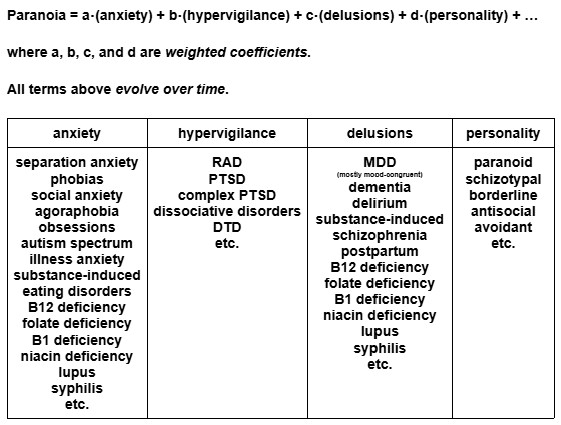
Many of us have seen weighted averages before. And if you have studied the equivalent of what is called Calculus II in the US, you have encountered Maclaurin series expansions as well. The above “equation” is inspired by Maclaurin series, which have infinitely many terms, but the first few terms make the greatest contributions to the “behavior” of the equation (they have the largest coefficients).
When we consider paranoia, many clinicians jump to the fifth row of the third column (i.e. schizophrenia). But what about all the other contributors to what patients call paranoia? Clinicians don’t use a uniform definition of paranoia either. In any case, paranoia is a complex and highly multifactorial phenomenon, so I wrote the pictured equation to help keep us thorough, comprehensive and protective for our patients.
At any point in time, a term might have zero contribution, so we would set its coefficient to zero (0). That way we don’t have to get bogged down by thinking about it too much. Of course, the coefficients (and thus the terms) will change in magnitude/weight over time.
Here is an example: a patient may have no delusions for all of childhood, adolescence, young adulthood, and middle adulthood. Let’s say in late life, they develop a dementia with associated delusions. In that case, coefficient c (of the delusions “term”) was stably zero for most of life then evolved to some positive value late in life.
The equation above is just an intentionally focused view of the list of transdiagnostic phenomena on the preceding page. Any item on that list can have its own Maclaurin-inspired equation written.
